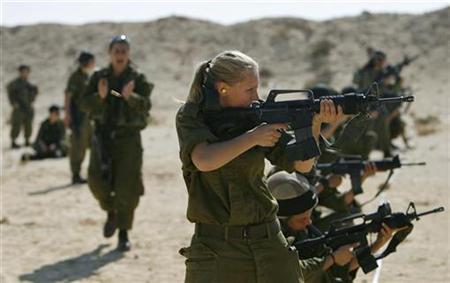
Should women be allowed to fight on the frontline? Is it time for complete equality in the armed forces? Is society ready for the idea of female soldiers routinely fighting and dying in combat?
More than the society being ready for it, the question arises why are women prevented from going into combat duty? Is it because they might be captured by the enemy and raped? Or worse, kept as pleasure objects for the enemy soldiers?
The death of Sergeant Sarah Bryant, the first female British soldier to be killed in Afghanistan, has reignited the long-running debate over women’s role in modern warfare.
The existing rules that exclude women from situations where the primary duty is “to close with and kill the enemy” are irrelevant in Afghanistan and Iraq where there is no single front line, according to some commentators.
Instead, British forces are engaged in a “360-degree war” where all soldiers, male or female, could be in the line of fire at any time, Catherine Philp wrote in the Times.
“In times gone by, rules like these kept women far behind the men,” she writes. “In the heat of the Iraq insurgency, however, all that began to change. In reality, the rules are already stretched to breaking point.”
The old arguments that women are not physically capable to fight or might disrupt “unit cohesiveness” no longer hold water, she added.
Necessity will bring about change.
The Ministry of Defence says there are now about 18,000 women in the armed forces, just under 10 percent of the total. The Sex Discrimination Act (1975) allows the armed forces to exclude women from some posts.
That’s the right approach, according to one contributor to an online military forum.
“I’ve yet to see a woman who could withstand the mental and physical pressure of infantry work,” he wrote.
That seems like an unfair generalization.
Not so, said Jo Salter, the RAF’s first female fighter pilot. She said society’s attitudes have changed over the years and the sex of a soldier is no longer the issue it once was.
“It’s always so sad when there’s any death at all. Gender isn’t the issue,” she told the Daily Telegraph.
That view was echoed by the parents of Flight Lieutenant Sarah-Jayne Mulvihill, who died in Iraq in 2006.
“Sarah did not distinguish between herself and the boys she served with,” her father Terry told the Daily Mirror. His wife Sue added: “There were four others with her and their families’ grief is equal.”
A quick look at the front pages after Bryant’s death suggests newspaper editors may not see it that way.
Pictures of Sgt Bryant in her wedding dress were splashed across several front pages under headlines such as “Our Afghan Heroine”. Most ran long stories on inside pages about her life and career in the army. The deaths of male soldiers typically receive far less coverage. There were few details of the three male colleagues killed with her.
Whether the media coverage of Bryant’s death reflects the wider views of society is hard to tell.
The last word goes to an unnamed military source who told the Herald newspaper: “Every man - and woman - is born equal under the 7.62mm gun law”.
More than the society being ready for it, the question arises why are women prevented from going into combat duty? Is it because they might be captured by the enemy and raped? Or worse, kept as pleasure objects for the enemy soldiers?
The death of Sergeant Sarah Bryant, the first female British soldier to be killed in Afghanistan, has reignited the long-running debate over women’s role in modern warfare.
The existing rules that exclude women from situations where the primary duty is “to close with and kill the enemy” are irrelevant in Afghanistan and Iraq where there is no single front line, according to some commentators.
Instead, British forces are engaged in a “360-degree war” where all soldiers, male or female, could be in the line of fire at any time, Catherine Philp wrote in the Times.
“In times gone by, rules like these kept women far behind the men,” she writes. “In the heat of the Iraq insurgency, however, all that began to change. In reality, the rules are already stretched to breaking point.”
The old arguments that women are not physically capable to fight or might disrupt “unit cohesiveness” no longer hold water, she added.
Necessity will bring about change.
The Ministry of Defence says there are now about 18,000 women in the armed forces, just under 10 percent of the total. The Sex Discrimination Act (1975) allows the armed forces to exclude women from some posts.
That’s the right approach, according to one contributor to an online military forum.
“I’ve yet to see a woman who could withstand the mental and physical pressure of infantry work,” he wrote.
That seems like an unfair generalization.
Not so, said Jo Salter, the RAF’s first female fighter pilot. She said society’s attitudes have changed over the years and the sex of a soldier is no longer the issue it once was.
“It’s always so sad when there’s any death at all. Gender isn’t the issue,” she told the Daily Telegraph.
That view was echoed by the parents of Flight Lieutenant Sarah-Jayne Mulvihill, who died in Iraq in 2006.
“Sarah did not distinguish between herself and the boys she served with,” her father Terry told the Daily Mirror. His wife Sue added: “There were four others with her and their families’ grief is equal.”
A quick look at the front pages after Bryant’s death suggests newspaper editors may not see it that way.
Pictures of Sgt Bryant in her wedding dress were splashed across several front pages under headlines such as “Our Afghan Heroine”. Most ran long stories on inside pages about her life and career in the army. The deaths of male soldiers typically receive far less coverage. There were few details of the three male colleagues killed with her.
Whether the media coverage of Bryant’s death reflects the wider views of society is hard to tell.
The last word goes to an unnamed military source who told the Herald newspaper: “Every man - and woman - is born equal under the 7.62mm gun law”.